How to Drain Your Property After a Storm With a Water Pump
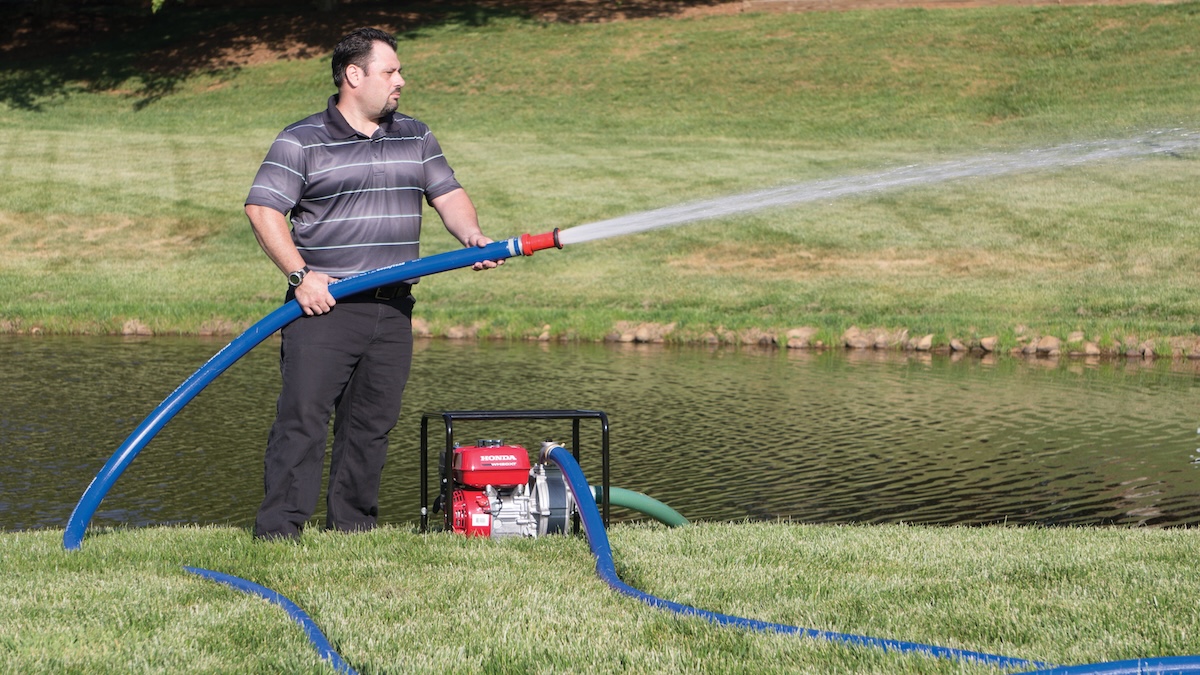
Standing water can keep you from getting your property back to normal after a storm. A properly selected Honda water pump can help move compatible water to an approved discharge area—but first, confirm that the property is safe and that the pump matches the job.
Start by checking for electrical, structural, and contamination hazards. Then evaluate the water, debris, required flow, and discharge route. This guide explains how to select, set up, and monitor a Honda water pump for storm cleanup. Refer to the owner’s manual for complete instructions.
But before you pump standing water out of a flooded yard, it is important to confirm the area is safe. Then, identify whether the water is clean or filled with debris, and choose an appropriate dewatering pump.
As a general rule of thumb, use a lightweight or general-purpose pump for relatively clean water and a trash pump for muddy water containing debris. A submersible pump may be appropriate for a basement sump or window-well application when the basin, water depth, float-switch clearance, discharge piping, and electrical supply meet the requirements in the model-specific owner’s manual.
In this guide from Honda, you’ll find out how to pump water out of your flooded yard, as well as:
- When it’s safe to begin pumping
- How to select the correct type of water pump
- The process for setting up the pump and hoses
- How to find a safe and permitted discharge location
- When to stop and call a professional
- Ways to address the underlying drainage problem before the next storm
Before You Pump: Make Sure the Area Is Safe
There are a few safety measures you should take before figuring out how to pump standing water out of your yard.
Wait Until the Immediate Flood Danger Has Passed
Don’t start pumping if:
- Water is still rising rapidly.
- Floodwater is moving across the property.
- Local officials have issued evacuation instructions.
- Lightning or other severe weather is still creating an immediate hazard.
- The ground beneath the equipment is unstable or eroding.
Check for Electrical and Utility Hazards
Don’t touch electrical equipment if it is wet or while you’re standing in water. Also, don’t enter a flooded basement to reach the breaker panel.
Have the power company or a qualified electrician disconnect or inspect power where necessary. Look for hazards like:
- Damaged wiring
- Submerged outlets
- Fuel odors
- Damaged gas lines
- Structural movement
FEMA and ready.gov both advise against touching wet electrical equipment or entering standing water to shut off power. The CDC recommends using an electric transfer pump or sump pump only after an electrician has determined that electricity can be used safely.
Identify Contaminated Water
Confirm that the water is compatible with the pump. Honda WX, WB, WT, and WH pumps are intended for fresh, non-potable water. Do not use them to pump seawater, gasoline, fuel oil, acids, chemical solutions, or other flammable or corrosive liquids. Muddy fresh water may require an appropriately sized trash pump. Always follow the limitations in the model-specific owner’s manual.
Call a professional if the water may contain:
- Sewage
- Fuel or oil
- Pesticides or other chemicals
- Septic-system overflow
- Unknown substances from a widespread flood
- Sharp debris or downed electrical lines
Keep in mind that even a “higher-solids” pump doesn’t make contaminated floodwater safe to handle.
Be Especially Careful With Flooded Basements
Rapidly removing deep basement water while the surrounding soil remains saturated can create unequal pressure against the foundation. FEMA guidance recommends gradual use of a water pump for flooded basements to reduce the risk of wall collapse or floor buckling. They advise pumping no more than approximately 1 foot of water per day. Contact a qualified structural or water-remediation professional before pumping when water is deep, exterior floodwater remains high, or the foundation shows signs of movement.
You should consider contacting a structural engineer or water-remediation professional if you notice any of the following:
- Basement water is several feet deep.
- Floodwater remains high outside the foundation.
- Walls are cracked, bowed or shifting.
- The floor has buckled.
- The home has moved off its foundation.
What Type of Water Pump Should You Use?
Before we explore how to pump standing water out of your yard or basement, here’s a quick guide to different types of pumps.
| Situation | Recommended Pump Type | Honda Models | Primary Consideration |
|---|---|---|---|
| Small amount of relatively clean yard water | Recommended Pump TypeLightweight centrifugal pump | Honda ModelsWX10 or WX15 | Primary ConsiderationPortability and simple setup |
| Larger volume of relatively clean stormwater | Recommended Pump TypeGeneral-purpose centrifugal pump | Honda ModelsWB20 or WB30 | Primary ConsiderationFaster dewatering and larger hoses |
| Muddy water with leaves and larger debris | Recommended Pump TypeTrash pump | Honda ModelsWT20 or another appropriately sized WT model | Primary ConsiderationSolids-handling capability |
| Basement, window well, or sump | Recommended Pump TypeElectric submersible pump | Honda ModelsWSP33 or WSP53 | Primary ConsiderationSafe electrical supply and GFCI protection |
| Long-distance delivery or sprinkler/nozzle application | Recommended Pump TypeHigh-pressure pump | Honda ModelsWH Series | Primary ConsiderationPressure and total head rather than drainage volume |
Note: Published maximum flow rates are not the amount every user will achieve. Actual flow depends on suction height, discharge height, hose diameter, hose length, fittings, and other system resistance. Pump output decreases as total head increases, so use hoses that are no longer than necessary, and position them as close to the water as you can safely achieve.
Lightweight Pumps for Smaller Yard-Drainage Jobs
The WX Series are clean-water pumps that are easy to transport and set up. Consider:
- Honda WX10: Its compact design makes it easier to carry between smaller low spots around your property. The published maximum capacity is 32 gallons per minute for qualifying applications involving relatively clean water. Includes a garden-hose adapter and is appropriate for smaller volumes of relatively clean water.
- Honda WX15: A 1.5-inch general-purpose pump weighing approximately 20 pounds, with a published capacity of up to 74 gallons per minute.
These compact models are ideal for smaller amounts of mostly clear water. If you need to pump water containing significant mud, sticks, or large debris, you may need something more robust.
General-Purpose Pumps for Larger Volumes of Water
Honda’s WB Series is best for moving a larger volume of relatively clean water.
The Honda WB20 has a 2-inch, self-priming centrifugal pump with a published capacity of up to 164 gallons per minute and a dry weight of approximately 44 pounds. Its 2-inch ports and published maximum capacity of 164 gallons per minute support larger-volume dewatering jobs involving relatively clean water. Actual output depends on total head and the complete hose system.
A 2- or 3-inch hose can move water much faster than a smaller garden-hose-based setup. However, the larger hose, increased water volume, and equipment weight require more careful placement and handling.
Trash Pumps for Muddy or Debris-Filled Water
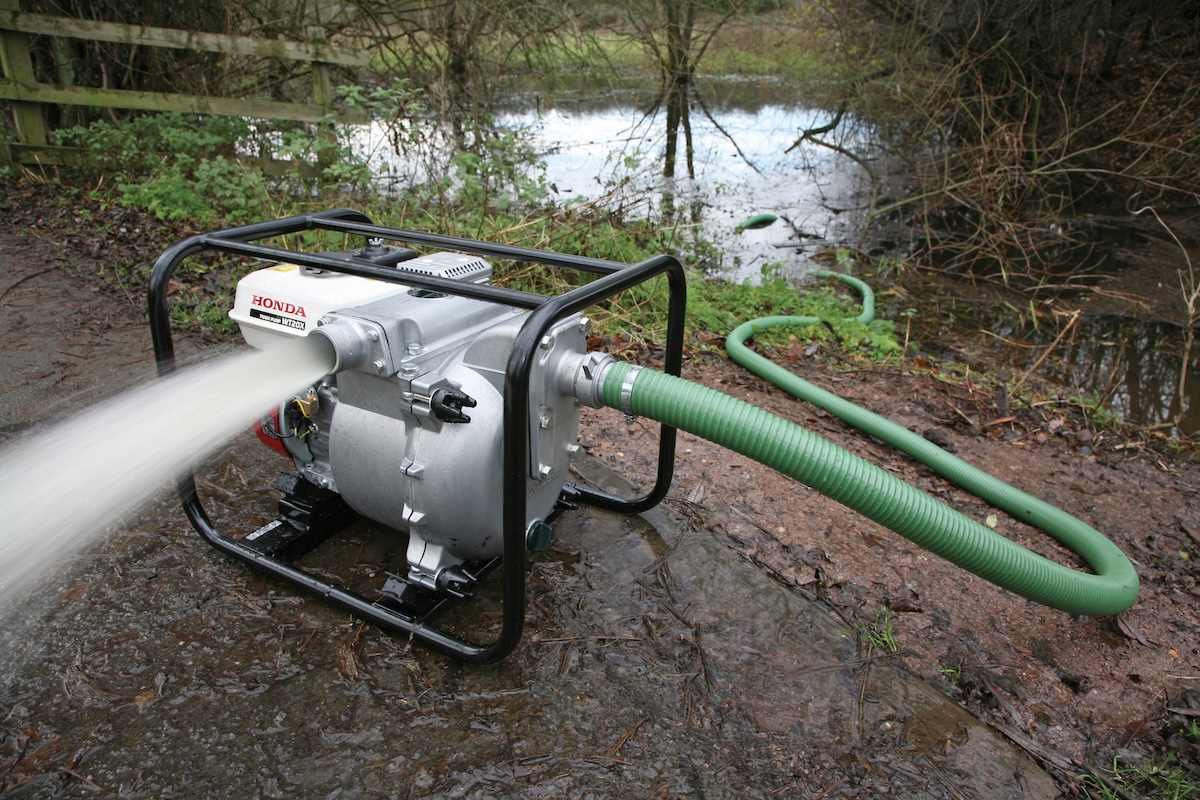
A trash pump is designed for stormwater containing debris that could clog a standard dewatering pump.
The Honda WT20, for example, is a 2-inch trash pump with a published capacity of up to 185 gallons per minute and the ability to handle solids up to 13/16 inches. Its ability to pass solids up to 13/16 inch makes it an option for muddy fresh water containing appropriately sized debris.
The term “trash pump” describes the pump’s ability to pass appropriately sized solids in fresh, non-potable water. It does not mean the pump is approved for seawater, flammable liquids, corrosive chemicals, or raw sewage.
Submersible Pumps for Basements and Window Wells
A submersible pump is placed in the water, while the discharge hose moves the water to a safe location. Honda’s WSP series includes models like:
- Honda WSP33: 1/3-horsepower, 115-volt submersible pump with a published capacity of up to 40 gallons per minute.
- Honda WSP53: A 1/2-horsepower, 115-volt submersible pump with a published maximum capacity of 70 gallons per minute and solids handling up to 3/8 inch.
A Honda WSP submersible pump may be appropriate for a qualifying basement sump or window-well installation. Confirm that the water depth, basin, float-switch clearance, discharge piping, and electrical supply meet the model-specific owner’s-manual requirements.
WARNING: Never plug in, unplug, or handle an electric pump while standing in water. Use a properly grounded, GFCI-protected supply and follow the model-specific owner’s manual. Electrical service affected by flooding must be inspected before use. Do not use an extension cord.
Do You Need a Pressure Water Pump for Your Home?
It may suit applications involving sprinklers, nozzles, a substantial rise in elevation, or a hose run that creates significant friction loss. For basic dewatering, focus first on water type, solids size, required flow, and total head. However, for standing water, pumps don’t necessarily need to be high-pressure.
For most storm cleanup equipment, the biggest considerations are water type, solids handling, and discharge volume. High-pressure requirements are most important when the discharge point is significantly higher or farther from the source.
We recommend the Honda WH series of water pumps for applications requiring additional pressure, like sprinklers, nozzles, and pumping over longer distances.
How to Pump Standing Water Out of Your Yard or Property
Step 1: Stop or Reduce the Source of the Water
Before pumping:
- Wait for active flooding to subside.
- Clear accessible leaves and debris from surface drains.
- Redirect downspouts temporarily once you’re able to do so without sending water toward another structure.
- Make sure there isn’t water flowing in from a broken water line or failed irrigation system.
Step 2: Estimate the Water and Debris Conditions
Try to identify:
- Approximate water depth
- Size of the flooded area
- Clear water versus silt, mud, and debris
- Largest visible solids
- Lowest point where the intake can be placed
- Vertical and horizontal distance to the discharge point
Here’s a volume formula you can use:
Estimated gallons = (flooded length in feet) × (width in feet) × (average depth in feet) × 7.48
This formula, while useful, is still only an estimate. Irregular yards and changing water depth will reduce accuracy.
Step 3: Choose a Legal and Safe Discharge Point
The discharge point should:
- Move water away from the house and foundation.
- Be stable enough to resist erosion.
- Not send water onto a neighboring property.
- Not create a hazard on a road, sidewalk, or driveway.
- Not flow back into the flooded area.
- Follow local stormwater, sewer, and environmental rules.
Don’t assume you can discharge water into a sanitary sewer or storm drain. Local rules vary, particularly when floodwater contains sediment, chemicals, sewage, or other pollutants.
Step 4: Position the Pump
For gas-powered WX, WB or WT pumps:
- Operate the engine outdoors only.
- Never place it in a basement, garage, crawlspace, shed, or other enclosed or partially enclosed area.
- Keep exhaust directed away from the home, doors, windows, vents, and occupied areas.
- Place the pump on a level, firm, and stable surface.
- Position it near the water level to minimize suction height.
- Keep it out of the water and away from unstable soil.
Engine exhaust from gas-powered water pumps contains carbon monoxide. Never operate a gas-powered pump in a closed or partially enclosed space. Operate a gas-powered water pump outdoors only, at least 20 feet from doors, windows, vents, and other building openings. Never operate it in a basement, garage, carport, porch, crawlspace, shed, or any enclosed or partially enclosed area. Follow all additional clearances in the model-specific owner’s manual.
Step 5: Connect the Suction and Discharge Hoses
For a centrifugal pump:
- Use a reinforced, non-collapsible suction hose.
- Confirm that gaskets, couplers, and clamps are properly installed.
- Attach the correct strainer to the suction hose.
- Keep the strainer above deep mud where possible.
- Route the discharge hose to the planned outlet.
- Remove sharp bends and avoid driving vehicles over the hose.
- Secure the hose end so it cannot move as water begins flowing.
Use a reinforced suction hose, and operate the pump with the strainer installed to help prevent clogging and pump damage.
Step 6: Prime the Pump
Most gas-powered centrifugal pumps must be filled with water before starting. Never start a centrifugal pump with an empty pump chamber.
Always follow the exact priming procedure in the model-specific owner’s manual. A submersible pump, for example, won’t use the same priming process.
Step 7: Start the Pump and Monitor the Water
During operation, watch for:
- Consistent discharge flow
- Collapsing or leaking hoses
- Clogged strainers
- Excessive vibration
- Fuel or oil leaks
- Erosion at the discharge point
- The intake beginning to pull air as water gets shallow
- Water returning toward the foundation
Don’t leave the pump unattended, particularly near children, pets, or public areas.
Step 8: Shut Down, Clean, and Store the Pump
After pumping:
- Turn the pump off according to the owner’s manual
- Allow a gas engine to cool before refueling, moving, or storing it
- Remove debris from the strainer
- Drain the pump housing and hoses
- Inspect hoses, gaskets, and clamps
Follow the storage procedure laid out in the manual, especially if the pump may not be used again for several months. It’s usually best to refuel outdoors with the engine stopped and cooled. Only use an approved fuel container.
Where Should You Pump Stormwater?
Here are some “do’s and don’ts” for where to pump stormwater.
Potential Discharge Locations, When Locally Permitted
Contact your local public works, stormwater, sewer, or environmental authority before selecting a discharge point. Depending on local requirements and water quality, a permitted option may include an appropriate area of the same property, an approved drainage swale, a designated stormwater connection, or an approved containment area.
The appropriate discharge location is subject to local rules. In most areas, you can discharge to:
- A lower area of the same property where water can disperse safely
- An approved drainage swale
- An approved stormwater pump outlet
- A landscaped area capable of absorbing the water without causing erosion
- A temporary storage or containment area approved for the type of water
Locations to Avoid
Avoid draining into areas like:
- Beside your home’s foundation
- A septic tank or drain field
- A neighbor’s property
- A roadway or pedestrian route
- A sanitary sewer unless specifically permitted
- A steep or unstable slope
- A location where the water will return to the flooded area
- Any stream, lake, wetland, drainage channel, or other public waterway unless the discharge has been expressly determined to be lawful and appropriate.
According to the EPA, stormwater runoff can carry dirt, fertilizer, oil, pesticides, bacteria, and other pollutants into waterways. Consequently, storm drains and streams may not be acceptable discharge locations, depending on the type of water.
When Should You Call a Professional?
If any of the following happens, you may need to call a professional:
- Floodwater is still rising or moving.
- Electrical equipment, outlets or wiring are submerged.
- The property has a gas or fuel odor.
- The water contains sewage, chemicals, or unknown contaminants.
- A basement contains deep water.
- Foundation walls are cracked, bowing, or shifting.
- The floor is buckling.
- There are sinkholes, washouts, or unstable slopes.
- The pump cannot keep up with incoming water.
- Water repeatedly enters the same area after moderate rain.
- A permanent French drain, sump system, grading change, or retaining structure is required.
- Local permits or stormwater approvals may be needed.
Refer to the owner’s manual for complete instructions.
How to Help Your Yard Drain Better Before the Next Storm
It’s important to remember that pumping is an emergency response, and not a permanent backyard drainage solution. Here are some preventative measures you can take.
Clean and Redirect Gutters and Downspouts
Clean any blocked gutters and repair disconnected or leaking downspouts. Make sure any extenders or splash blocks are approved for use with your downspouts. Direct roof runoff toward an appropriate landscaped area and away from the foundation.
The University of Minnesota lists gutters, downspout extensions, and proper surface grading as first-line measures for many basement and surface-water problems.
Correct Low Spots and Improper Grading
A qualified drainage or landscaping professional can evaluate grading issues such as:
- Soil that slopes toward your house
- Depressions that collect water
- Compacted soil
- Eroded swales
- Settled soil near the foundation
Appropriate grading depends on the property, foundation, soil, codes, and nearby drainage systems. There is no one-size-fits-all slope specification.
Consider a Rain Garden, Swale, or Permeable Surface
Potential prevention measures for drainage issues include:
- Rain gardens
- Vegetated swales
- Permeable pavement
- Rain barrels or cisterns
- Reduced impervious surface area
- Trees and deep-rooted vegetation
The EPA recommends practices like redirected downspouts, rain barrels, rain gardens, trees, and permeable surfaces to reduce runoff.
Install a Permanent Drainage System Where Needed
Here are some professional solutions you might consider:
- Catch basins
- Channel drains
- French drains
- Exterior foundation drainage
- Sump pumps with backup power
- Regrading
- Erosion-control systems
None of these solutions are universal DIY fixes. An incorrectly installed drain can move water toward the home, affect neighboring properties, or violate local requirements.
Prepare Your Water Pump Before Storm Season
Before storm season arrives, run through this annual checklist:
- Read the owner’s manual.
- Inspect hoses, clamps and strainers.
- Confirm that the correct adapters are available.
- Check engine oil and fuel condition on gas models.
- Test-start your equipment outdoors.
- Check electric pump cords and float switches.
- Identify possible discharge routes before a storm.
- Keep personal protective equipment nearby.
.jpg)
Find the Right Honda Pump for Storm and Property Flood Cleanup
So, how do you pump water out of your yard? We recommend these Honda home water pump series:
- Honda WX Series: Smaller, relatively clean-water jobs where portability is important
- Honda WB Series: Larger-volume general dewatering
- Honda WT Series: Muddy water containing leaves and larger debris
- Honda WSP Series: Basements, window wells, and other submersible applications where electricity is confirmed safe
- Honda WH Series: Applications requiring additional pressure or longer-distance delivery
Explore Honda water pumps and compare models based on water type, solids-handling requirements, flow, and total head. A Honda dealer can also help you evaluate the right pump for your application.
FAQs
How do I pump water out of my yard?
To pump water out of your yard:
- Assess safety
- Identify water conditions
- Choose the pump
- Plan the discharge route
- Connect and prime the equipment
- Monitor pump operation
What kind of pump removes standing water from a yard?
Lightweight pumps are ideal for removing a small volume of relatively clean yard water. General-purpose pumps are better for larger volumes of clean stormwater, and trash pumps are best for muddy water with debris.
Can I use a water pump to drain a flooded yard?
Yes, when the area is safe, and there is an appropriate location to discharge the water. Pumping is usually unsafe during active flash flooding.
How do I pump muddy water out of my yard?
Choose a correctly sized trash pump based on the size of the debris. Seek professional assistance for sewage or chemically contaminated water.
Can I use a gas-powered pump in my basement?
No, gas-powered pumps produce carbon monoxide and must only be operated outdoors.
What pump should I use for a flooded basement?
A submersible transfer or sump pump may be appropriate after electrical and structural conditions have been confirmed safe.
Can pumping a basement too quickly damage it?
Yes, the pressure imbalance created by rapidly removing water from a basement can damage your foundation. FEMA recommends gradually pumping water out of the basement, at no more than approximately one foot of water per day.
Where should I pump water from my yard?
Check your local regulations to identify an approved location away from the home that will not affect neighboring property, roads, septic systems, or waterways.
How long does it take to pump water out of a yard?
How long it takes to pump water out of a yard depends on estimated water volume, actual pump output, hose arrangement, and continuing inflow.
Does a larger hose drain a yard faster?
Generally, a larger pump and hose can move more water, but actual performance depends on the complete pumping system and total head.
Do I need a pressure water pump for home drainage?
Usually a high-pressure pump isn’t necessary for home use. High-pressure pumps serve different applications from standard dewatering pumps.
How can I help my yard drain better after rain?
Some of the best preventative measures you can take for future drainage problems include downspouts, grading, swales, rain gardens, permeable surfaces, and professionally designed drainage systems.