Top 5 Honda Generators for RVs and Camping
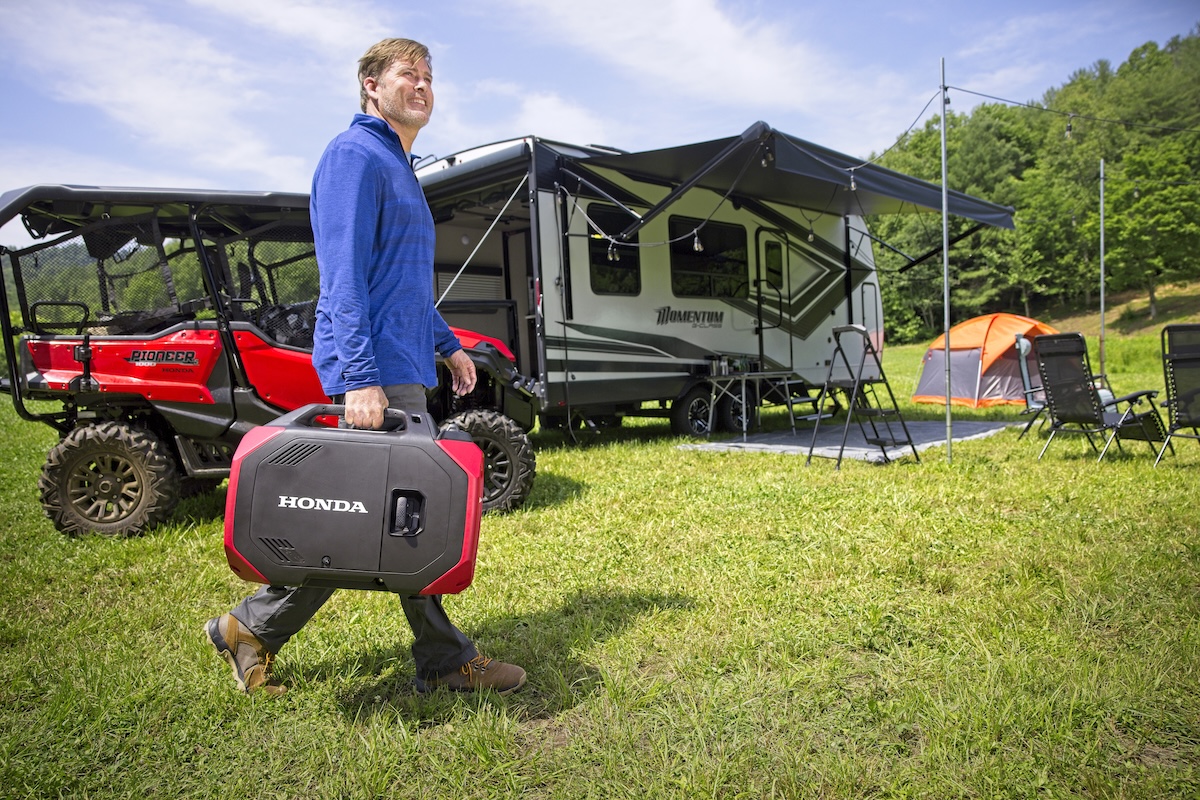
The best generator for RV camping depends on your power needs. A Honda EU2200i may be sufficient for lights, fans, electronics and small appliances, but running an RV air conditioner generally calls for a larger model or a parallel-generator setup.
In this guide, we’ll compare five Honda generators across different camping use cases. We’ll show you how to calculate the required RV generator size for your needs. You’ll also learn the differences between light camping loads, powering one RV air conditioner, and even larger RV power needs.
Because there’s no one answer when trying to decide on what size generator for RV camping, you’ll need to explore what each model has to offer. We’ll compare features across generators based on portability, runtime, outlets, Bluetooth® capability, and safe operation.
Remember that wattage requirements vary by appliance and RV. Always check appliance labels, RV documentation, and Honda’s wattage calculator before choosing a generator for camping.
Quick Comparison of the Best Honda Generators for RVs and Camping
| Model | EU2200i | EU2200i Companion | EU3000iS | EU3200i | EU7000iS |
|---|---|---|---|---|---|
| Maximum/Rated Output | 2,200W / 1,800W | 2,200W / 1,800W | 3,000W / 2,800W | 3,200W / 2,600W | 7,000W / 5,500W |
| Best Use Case | Best for lightweight camping power and smaller RV loads | Best for 30A RV generator flexibility and a future parallel setup | Best for long runtime and electric-start convenience | Best for higher output in a comparatively lightweight package | Best for large RVs, fifth wheels and more demanding power requirements |
| RV Air Conditioning Guidance | Generally not enough starting power for an RV AC | Generally not enough starting power for an RV AC | Can start most RV air conditioners | Can start standard RV air conditioners | Can power a large AC unit and other RV appliances at the same time |
| Starting System | Recoil | Recoil | Recoil, electric | Recoil | Recoil, electric |
| Runtime | 3.2–8.1 hours | 3.2–8.1 hours | 6.9–19.6 hours | 3.2–8.6 hours | 6.4–16 hours |
| Dry Weight | 47.4 lb. | 47.4 lb. | 130.7 lb. | 59.1 lb. | 263.2 lb. |
| 30A Connection/Adapter Considerations | Unit only has 15A/120V outlets | Built-in 30A outlet, requires an adapter for 4-prong 50A plugs | Built-in 30A outlet, requires an adapter for 4-prong 50A plugs | Includes 30A RV receptacle, requiring locking RV adapter | Includes a switching 30A/50A RV receptacle |
| Bluetooth®/Honda My Generator App Capability | Yes | Yes | No | Yes | Yes |
| Primary Tradeoff | Not enough power for heavy appliances or an RV | Requires two parallel-linked units to run an RV air conditioner | Heavy weight, and requires an adapter | Higher price point, louder noise when running at high power | Much heavier than other units |
| Model | Maximum/Rated Output | Best Use Case | RV Air Conditioning Guidance | Starting System | Runtime | Dry Weight | 30A Connection/Adapter Considerations | Bluetooth®/Honda My Generator App Capability | Primary Tradeoff |
|---|---|---|---|---|---|---|---|---|---|
| EU2200i | Maximum/Rated Output2,200W / 1,800W | Best Use CaseBest for lightweight camping power and smaller RV loads | RV Air Conditioning GuidanceGenerally not enough starting power for an RV AC | Starting SystemRecoil | Runtime3.2–8.1 hours | Dry Weight47.4 lb. | 30A Connection/Adapter ConsiderationsUnit only has 15A/120V outlets | Bluetooth®/Honda My Generator App CapabilityYes | Primary TradeoffNot enough power for heavy appliances or an RV |
| EU2200i Companion | Maximum/Rated Output2,200W / 1,800W | Best Use CaseBest for 30A RV generator flexibility and a future parallel setup | RV Air Conditioning GuidanceGenerally not enough starting power for an RV AC | Starting SystemRecoil | Runtime3.2–8.1 hours | Dry Weight47.4 lb. | 30A Connection/Adapter ConsiderationsBuilt-in 30A outlet, requires an adapter for 4-prong 50A plugs | Bluetooth®/Honda My Generator App CapabilityYes | Primary TradeoffRequires two parallel-linked units to run an RV air conditioner |
| EU3000iS | Maximum/Rated Output3,000W / 2,800W | Best Use CaseBest for long runtime and electric-start convenience | RV Air Conditioning GuidanceCan start most RV air conditioners | Starting SystemRecoil, electric | Runtime6.9–19.6 hours | Dry Weight130.7 lb. | 30A Connection/Adapter ConsiderationsBuilt-in 30A outlet, requires an adapter for 4-prong 50A plugs | Bluetooth®/Honda My Generator App CapabilityNo | Primary TradeoffHeavy weight, and requires an adapter |
| EU3200i | Maximum/Rated Output3,200W / 2,600W | Best Use CaseBest for higher output in a comparatively lightweight package | RV Air Conditioning GuidanceCan start standard RV air conditioners | Starting SystemRecoil | Runtime3.2–8.6 hours | Dry Weight59.1 lb. | 30A Connection/Adapter ConsiderationsIncludes 30A RV receptacle, requiring locking RV adapter | Bluetooth®/Honda My Generator App CapabilityYes | Primary TradeoffHigher price point, louder noise when running at high power |
| EU7000iS | Maximum/Rated Output7,000W / 5,500W | Best Use CaseBest for large RVs, fifth wheels and more demanding power requirements | RV Air Conditioning GuidanceCan power a large AC unit and other RV appliances at the same time | Starting SystemRecoil, electric | Runtime6.4–16 hours | Dry Weight263.2 lb. | 30A Connection/Adapter ConsiderationsIncludes a switching 30A/50A RV receptacle | Bluetooth®/Honda My Generator App CapabilityYes | Primary TradeoffMuch heavier than other units |
What Size Generator Do You Need for an RV or Camping?
Knowing what size generator for an RV or camping you need starts with figuring out how many appliances you will power, as well as weight limits and must-have features. Here are some factors informing how to choose a generator for RV use:
Start With Everything You Want to Power
First, divide your equipment into two groups:
Basic Camping Loads:
- LED lights
- Cellphones and tablets
- Laptop computers
- Portable fans
- Television or entertainment equipment
- Air-mattress pump
- Coffee maker or small kitchen appliance
Higher-Demand RV Loads:
- RV air conditioner
- Microwave
- Refrigerator
- Hair dryer
- Electric cooking equipment
- Water heater or other onboard equipment
You can usually operate several smaller items together with one camping power source, but you may need to manage high-draw appliances one at a time.
Understand Starting Watts and Running Watts
Your appliances use running watts while operating normally. Starting watts, on the other hand, are the temporary additional power certain motors and compressors require at startup.
Air conditioners, refrigerators, and other motor-driven equipment can require substantially more power when starting. That means the generator has to accommodate the highest startup event as well as the other loads already operating.
Honda’s recreational wattage guide estimates a 13,500-BTU RV air conditioner generator should have at least 2,800 starting watts and 1,800 running watts. Estimates for a 15,000-BTU unit are approximately 3,300 starting watts and 2,000 running watts.
Keep in mind that these are planning estimates. Always verify the actual equipment specifications.
Decide Whether You Need to Run an RV Air Conditioner
Here are some example scenarios:
- No RV air conditioner: Your Honda EU2200i may provide sufficient portable power when camping with lights, electronics, fans, small swamp coolers, and selected appliances, depending on the combined load.
- One typical 13,500-BTU RV air conditioner: Consider the Honda EU3000iS, EU3200i or an appropriately configured EU2200i and EU2200i Companion parallel setup.
- Two RV air conditioners: Powering two air conditioning units is often more than a consumer grade generator can handle. Air-conditioner size, simultaneous startup, soft-start equipment, RV wiring, and other operating appliances all affect the result.
Consider More Than Wattage
Besides wattage, you should also factor in:
- Weight (including considerations for vehicle payload and whether one or two people will move the generator)
- Storage dimensions
- Runtime at expected load
- Recoil vs electric start
- Noise level
- Fuel capacity
- 20A and 30A receptacles
- Required RV adapters
- Parallel capability
- Bluetooth® monitoring
- Campground generator-hour restrictions
- Local regulations and fire restrictions
Our Top Generators for RVs and Camping
1. Honda EU2200i — Best for Lightweight Camping Power
The EU2200i is a good portable generator for travelers who primarily need power for lights, a fan, phone charging, a laptop, entertainment equipment, an air-mattress pump, and selected small appliances.
Honda EU2200i features include:
- 2,200 maximum watts
- Lightweight design at just over 47 lbs
- Runtime of approximately up to 8.1 hours, depending on load
- Stable inverter power for electronics
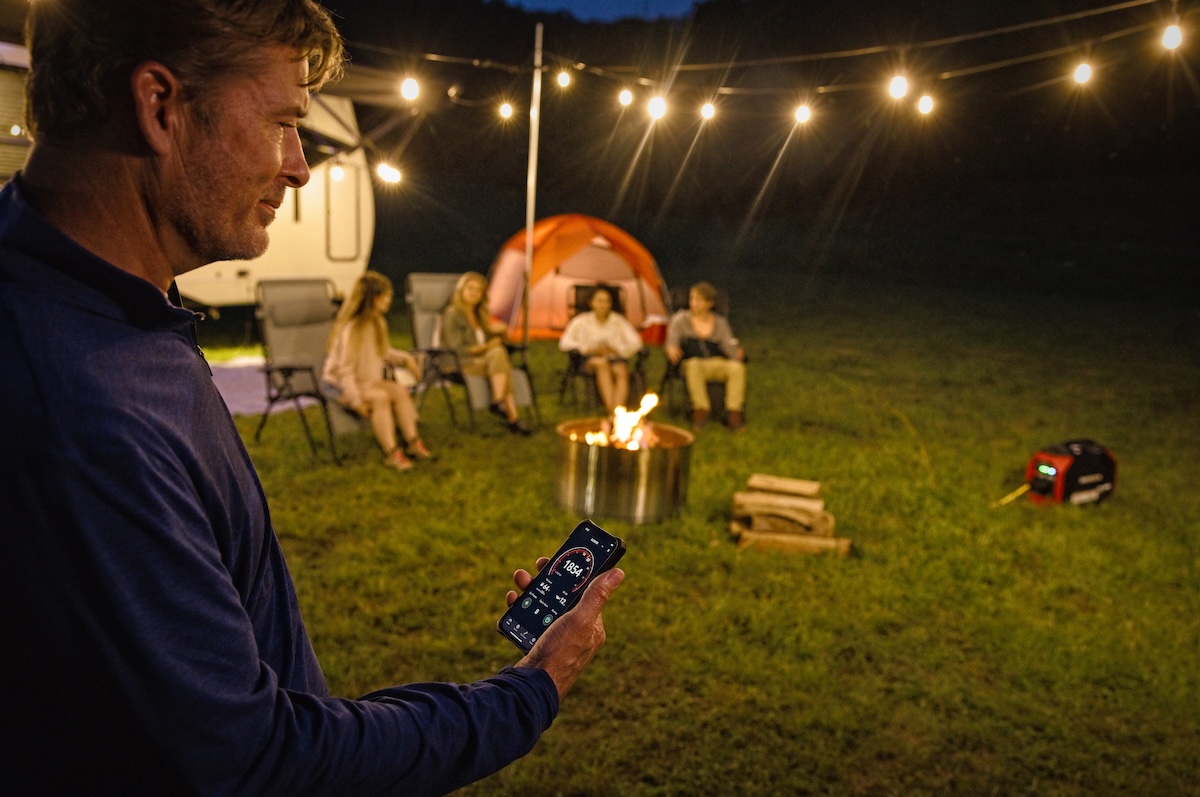
- Bluetooth® capability through the Honda My Generator app
- CO-MINDER™: advanced carbon monoxide detection system
- Parallel capability when additional power is needed
- Super quiet and lightweight
The EU2200i is appropriate for camping and supplemental RV power. It has output suitable for items such as televisions, refrigerators, coffee makers and other appliances, subject to total load.
One EU2200i will not be compatible with all RV air conditioners. Smaller A/C units and specific configurations may vary, so you must verify actual startup wattage.
2. Honda EU2200i Companion — Best for RV Connection and Expandable Power
The EU2200i Companion is a good choice for outdoor enthusiasts who want lightweight camping power now, with the ability to add an EU2200i for larger RV loads later.
Honda EU2200i Companion features include:
- 2,200 maximum watts as a standalone generator
- Built-in 30A receptacle for RV applications (adapter required for 50A RV connections)
- Similar lightweight portability to the standard EU2200i
- Bluetooth® app capability
- CO-MINDER™: advanced carbon monoxide detection system
- Parallel capability with a compatible EU2200i
- Super quiet and lightweight
A regular EU2200i and an EU2200i Companion can provide up to 4,400 maximum watts when connected correctly with Honda-approved parallel equipment. The EU2200i Companion’s 30A receptacle is designed to simplify this style of RV application.
Why use two small generators for camping instead of one large unit? Many RV owners prefer two smaller units because each generator is easier to lift and store than one substantially heavier generator. For lighter trips, you can bring just one unit.
With Honda’s parallel generators for RV camping, both units can be connected for higher output. The configuration requires two generators, appropriate cables and more setup than a single larger model.
3. Honda EU3000iS — Best for Long Runtime, Quiet Operation, and Electric Start
The EU3000iS is best suited to RV owners who prioritize long runtime, quiet operation and electric-start convenience over low carrying weight.
Honda EU3000iS features include:
- 3,000 maximum and 2,800 rated watts
- Recoil and electric starting
- Approximately 6.9 hours at rated load and up to 19.6 hours at one-quarter load
- 3.4-gallon fuel tank
- Optional wheel kit for easy moving
- Approximately 130.7-lb dry weight
- 30A locking receptacle
- Inverter power and CO-MINDER™
- Suitability for most 13,500-BTU RV air conditioners, subject to actual equipment requirements
The Honda EU3000iS is designed specifically for RV power and most 13,500-BTU RV air-conditioner applications. Its primary advantages over the EU3200i are electric start and substantially longer maximum runtime. However, it’s also much heavier.
4. Honda EU3200i — Best Higher-Output Lightweight Option (Portable and Fuel Injected)
The EU3200i is a strong choice for RV owners who want enough output for many 13,500-BTU RV air conditioners in a generator that is considerably lighter than the EU3000iS.
Honda EU3200i features include:
- 3,200 maximum and 2,600 rated watts
- Quiet operation
- 59.1-lb dry weight
- Integrated carrying handles
- Recoil starting
- Approximately 3.3 hours at rated load and up to 8.6 hours at one-quarter load
- 30A locking receptacle
- Bluetooth® capability and Honda My Generator app support
- Stable inverter output
- CO-MINDER™
The Honda EU3200i can power most 13,500-BTU RV air conditioners and is well suited for RVing, outdoor events, and other portable power needs. Compared with the Honda EU3000iS, the EU3200i offers higher maximum output in a substantially lighter package, while the EU3000iS provides higher rated output, electric start, and longer runtime.
Here’s a quick comparison of the Honda EU3000iS and EU3200i:
| Model | EU3000iS | EU3200i |
|---|---|---|
| Dry Weight | 130.7 lb. | 59.1 lb. |
| Starting System | Recoil, electric | Recoil |
| Maximum/Rated Output | 3,000W / 2,800W | 3,200W / 2,600W |
| Model | Dry Weight | Starting System | Maximum/Rated Output |
|---|---|---|---|
| EU3000iS | Dry Weight130.7 lb. | Starting SystemRecoil, electric | Maximum/Rated Output3,000W / 2,800W |
| EU3200i | Dry Weight59.1 lb. | Starting SystemRecoil | Maximum/Rated Output3,200W / 2,600W |
5. Honda EU7000iS — Best for Large RVs and Demanding Loads
The EU7000iS is the high-output option for larger RVs, fifth wheels and customers who need to operate multiple significant loads. However, you should calculate the complete electrical demand of all your appliances.
Honda EU7000iS features include:
- 7,000 maximum and 5,500 rated watts
- 120V/240V output
- Recoil and electric starting
- Approximately up to 16 hours
- 5.1-gallon fuel tank
- Folding handles and wheels
- Bluetooth® app capability
- Electronic fuel injection
- CO-MINDER™
- Suitability for RV applications and high-demand recreational power
The EU7000iS is a high-power model suitable for RVs, outdoor events, and other higher-output uses.
Important safety note: Never operate the EU7000iS while it’s inside a pickup-truck bed, RV storage bay, cargo compartment, or other enclosure. The unit may be transported in a truck bed, but it must be completely removed from the vehicle or trailer and placed in a safe outdoor location before operation. Honda’s operating guidance specifically warns against operating a portable generator in a vehicle, trailer, storage enclosure, or RV generator bay.
Which Honda Generator Fits Your Camping Setup?
Tent Camping or Basic Electronics
Start with the Honda EU2200i for light power needs, such as:
- Lighting
- Charging devices
- Fans
- Laptop use
- Air-mattress pumps
- Selected small appliances
Camper or Travel Trailer Without Air Conditioning
The Honda EU2200i or EU2200i Companion are good choices for a small trailer. The final decision comes down to your outlet needs and if parallel operation is part of your future plans.
RV With One 13,500-BTU Air Conditioner
For a single AC unit, the right generator varies based on your specific use case:
- Honda EU3000iS: Best for electric start and longer runtime
- Honda EU3200i: Best for lower weight and Bluetooth® capability
- Honda EU2200i plus EU2200i Companion: Ideal for modular portability
Always verify A/C startup wattage and the load from other appliances before selecting a generator.
Larger Fifth Wheel or High-Demand RV Setup
The Honda EU7000iS is a good choice for those with greater calculated power needs, such as a fifth-wheel generator. Keep in mind, however, that appliances may need to be sequenced. Dual-A/C operation is also configuration-dependent.
One Large Generator or Two Smaller Generators?
| Setup | Honda EU2200i plus Companion | Honda EU3000iS or EU3200i | Honda EU7000iS |
|---|---|---|---|
| Advantages | Easier individual lifting, flexible output, 30A parallel connection | One generator, simpler setup | Higher rated output, electric start |
| Considerations | Two engines to fuel and maintain, additional setup and cables | Different tradeoffs in weight, runtime and starting system | Heavier, requires careful transport and placement |
| Setup | Advantages | Considerations |
|---|---|---|
| Honda EU2200i plus Companion | AdvantagesEasier individual lifting, flexible output, 30A parallel connection | ConsiderationsTwo engines to fuel and maintain, additional setup and cables |
| Honda EU3000iS or EU3200i | AdvantagesOne generator, simpler setup | ConsiderationsDifferent tradeoffs in weight, runtime and starting system |
| Honda EU7000iS | AdvantagesHigher rated output, electric start | ConsiderationsHeavier, requires careful transport and placement |
Tips for Camping With a Generator
Check Campground Generator Rules Before Arriving
Generator hours, generator-free loops, and permitted noise levels vary by campground. Parks and campgrounds often restrict generators to designated daytime windows or prohibit them in certain loops. A quiet generator for camping usually means fewer than 60 dBA.
Before running your generator on a campground, verify:
- Permitted hours
- Generator-free areas
- Noise limits
- Fire restrictions
- Fuel-storage rules
- Whether generators may be left unattended
Position the Generator Safely
Here are some important safety considerations to note:
- Only operate the generator outdoors.
- Keep generators away from the RV, tent, doors, windows, and vents.
- Point exhaust away from occupied areas.
- Never operate generators in an RV bay, tent, garage, truck bed, under an enclosed awning, or in another enclosed or partially enclosed area.
- Follow the owner’s manual and use working CO alarms in the RV.
CPSC recommends operating portable generators outdoors at least 20 feet from homes, with exhaust directed away from the structure. It’s best to follow that guidance while using Honda generators for camping as well, keeping generators at least 20 feet away from sleeping areas and pointing exhaust away from the site.
Protect the Generator From Weather Without Enclosing It
Your generator should always remain dry and well ventilated. Refer to the owner’s manual for approved operating conditions.
Manage Your Electrical Load
To get the best performance out of your Honda generator:
- Start high-demand equipment separately (e.g., avoid turning on the air conditioner and microwave at the same time).
- Monitor generator load.
- Turn off nonessential appliances during compressor startup.
- Use only appropriate cords, adapters and Honda-approved parallel equipment.
- Consider sequencing high-starting-wattage appliances in some cases to allow a smaller generator to serve the required loads.
Find the Right Honda Generator for Your Next Trip
Here are the best use cases for each model:
- Honda EU2200i: Basic camping and smaller RV loads
- Honda EU2200i Companion: RV connection flexibility and parallel expansion
- Honda EU3000iS: Long runtime and electric start
- Honda EU3200i: Higher output with lower weight
- Honda EU7000iS: Larger RVs and more demanding calculated loads
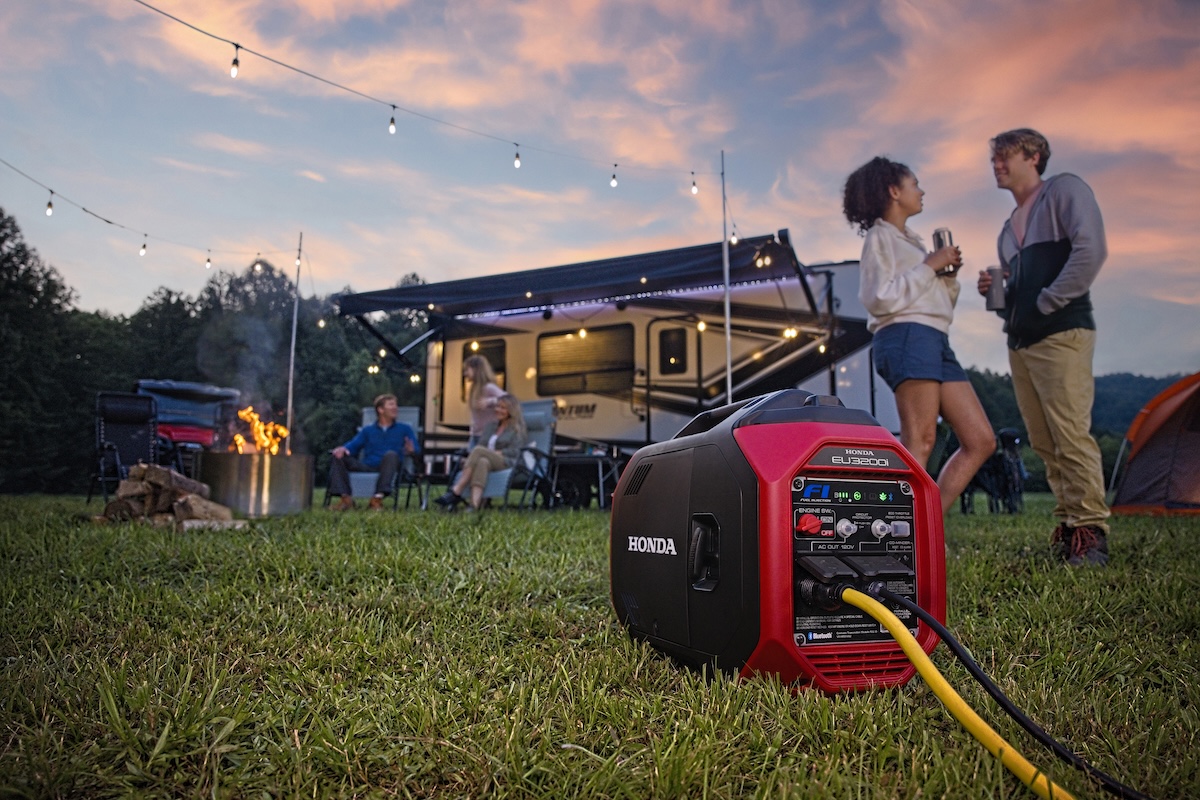
Not sure which generator is right for your appliances? Try Honda’s wattage calculator to see which model has enough power.
Shop Honda’s selection today, and find the right generator for your RV and camping adventures. You can also use our dealer locator tool to get started with your generator journey.
Frequently Asked Questions
What size generator do I need for an RV?
The right generator size for your RV depends on appliances, starting watts versus running watts, and whether you plan to run an air conditioner.
Is a 2,200-watt generator enough for an RV?
2,200 watts may be enough for lights, electronics, a refrigerator and selected appliances, but not necessarily an RV air conditioner or several high-draw appliances simultaneously.
What size generator will run a 13,500-BTU RV air conditioner?
For a 13,500 BTU RV air conditioner, you’ll need roughly 2,800 starting watts and 1,800 running watts. Always verify the specifications of your air conditioner unit.
Can an EU2200i and EU2200i Companion run an RV air conditioner?
While one Honda EU2200i or EU2200i Companion doesn’t have enough power for an RV air conditioner, you can link two units in a parallel setup for up to a 4,400-watt maximum output. Confirm actual A/C and simultaneous load requirements before using a parallel setup.
Should I choose the EU3000iS or EU3200i for my RV?
The Honda EU3000iS and EU3200i have similar power outputs, but there are some important distinctions:
- EU3000iS: electric start and longer runtime
- EU3200i: lower weight, more maximum output, and Bluetooth® capability
Can the EU7000iS run two RV air conditioners?
Whether you can power two RV air conditioners depends on:
- Each unit’s starting and running wattage
- Whether they start simultaneously
- Other onboard loads
- Soft-start equipment
- RV electrical configuration
Can I operate a generator in the bed of my truck?
No, you should never operate a portable generator in a truck bed. You can use the truck bed for transportation, but Honda guidance requires removing the generator completely from the vehicle or trailer before operation.
Can I run a camping generator overnight?
You may be able to run camping generators overnight, but only where campground rules permit and all safety requirements can be followed. Always check generator quiet hours and rules about unattended operation.
Are Honda inverter generators safe for computers and electronics?
Honda portable inverter generators for RVs provide stable output to minimize risk to sensitive devices. However, you should check your device for warnings about use with a generator and maximum input ratings.
What is CO-MINDER™?
Honda’s exclusive CO-MINDER™ feature monitors carbon-monoxide levels near the generator and can shut the generator down when elevated levels are detected. Keep in mind that this feature does not make it safe to operate a generator indoors, in enclosed spaces, or when improperly positioned.